Thursday, February 13, 2014

Helplessly virtuous? I don't think so.

My Grandma used to tell us a silly joke using a napkin.  She would pinch the napkin together and hold it under her nose like a mustache saying, "You must pay the rent!" with a forceful voice.  The napkin would then be moved to her hair like a bow and a little lady voice would say, "But I can't pay the rent!" This would be repeated two or three times until the napkin would be placed at her throat like a bow tie and a heroic voice would declare, "I'll pay the rent!".  At which point the napkin would go back to the hair and the lovely lady would sigh, "My hero!".  In many ways, this little joke could be considered a microcosm of the expectations of romance readers.
Do you recall the days when it was unseemly behavior to take a walk with a gentleman without a chaperon?  Do you remember your mother warning you not to let anyone take liberties with your person?  Did she admonish you to wear a hat and gloves at all times?  Perhaps you were the cause of a scandal in your social circle because your dress was too short to cover your ankles and the sight of them might drive a man mad with desire.  Did your mother advise you as to the proper place of a woman and teach you the accepted womanly virtues?  How many summer days did you spend inside learning to paint, embroider, and play the piano or sing?
The reality is that very few of us, if any, spent our days studying what are considered gentle, feminine tasks.  Romance authors today seem to have realized that in order for modern audiences to identify with their heroines, they need to create women who are different or rebellious for their time period.  After all, who can sympathize with a simpering nitwit who sits helplessly in a corner weeping while she waits for a man to notice her? Today's readers are dissatisfied with characters who refuse to be assertive on their own behalf.  When it comes to romance, an author must follow a fine line that allows the hero to be a hero and the woman to be a lady.  They can't be too good...and they can't be too bad.
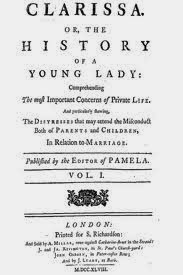
Even the title page is difficult to read.
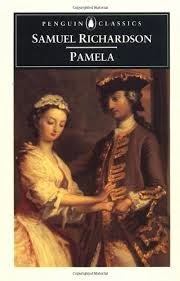
Samuel Richardson was one of the first authors to write about the trials of love. Pamela (or Virtue Rewarded), first published in 1740, is an epistolary novel which means that events are revealed mainly through the use of letters. Pamela is a lovely, innocent young housemaid. Her employer passes away which leaves her unprotected and alone.  Her employer's son, begins a campaign to seduce Pamela (who is only 15) and make her his mistress.  No one will intercede on her behalf due to her lowly origins and her employer's social standing.  When things finally come to a climax and Mr. B realizes that his behavior is hurting her, he decides to let her go.  However, a few notes and letters later, Pamela realizes that she is in love with Mr. B (which he has also conveniently realized).  A few letters later, Pamela has learned her role as wife and Mr. B's family has come to accept her.
It seems like this book hits all the right notes when it comes to romance. However, Pamela spends much of her time writing letters, unable to make a decision as to her own welfare.  The reader eventually grows extremely impatient with the heroine.  Why would anyone continue to stay in a house where someone is trying to force their unwanted attentions on you?  (In modern times, the man would probably be sent to jail for his behavior.)
Richardson's second novel, Clarissa, ends tragically.  Though it is filled with intrigue, dueling, kidnapping, danger and romance, it is another hefty epistolary novel.  Unlike Pamela, Clarissa is a bit more bold and daring as a heroine as she is brave enough to escape her tormentor.  Unlike Pamela, although she has escaped, her virtue is rewarded by dying of an illness caused by the mental distress of being pursued relentlessly.  (Yes, she was so stressed out that a guy she didn't like wouldn't leave her alone, she sickened and died.)  To our modern minds, that is probably the point at which the story becomes a farce.
Jane Austen is the author who has set the standard of modern romance.  The majority of romances today tend to follow a plot line that is similar to Pride and Prejudice.  If an author neglects to create a conflict between the attracted parties; if all goes well from the first time their eyes meet across a crowded room, the book is not believable. If the reader cannot become invested into the positive outcome of the relationship, they'll put down the book.  Romance readers may pick up a book to escape into something that they know isn't real but they still expect the story to be authentic.  They know that most of the men walking down the street are not dukes, spies, billionaires or Navy SEALs, but they still want to pretend that those men might be out there. And what is wrong with enjoying a relaxing romantic interlude with one of these guys for just a few short hours?

Monday, January 20, 2014

No Terms, Conditions, or Annoying Emails; our book recommendations are free!

Some people love to give advice.  Over the years, our society has taken advice from a wide variety of newscasters, forecasters, and talk show hosts.  On a more personal level, most of us have received counseling on some issue (whether we wanted it or not) from friends and family and even the occasional stranger.  Unfortunately, this dispensing of wisdom doesn't always work out in the way it was intended. Good advice gone bad (or just plain bad advice) has ruined many a friendship, family reunion, and meal.
One of the few places where it is safe to ask for recommendations on something you might enjoy is the library.  Book recommendations or readers' advisory is a service that has been steadily growing over the years.  This is done with an open mind and the understanding that patrons are not going to like every book they're given.
I was recently asked for a historical fiction recommendation and cited Wolf Hall by Hilary Mantel.  (This title came to mind first because it's on my personal to-read list.)  It's an award-winning book which contains the preferred setting and time frame of the requester.  After a few weeks the reader determined that this particular title was not for them.  That's going to happen.  It's the danger of giving advice.  The goal is to not take the rejection personally, and to have a better suggestion (like Bernard Cornwell's Saxon Tales or Alison Weir) in mind for that person when they come back.
Why are readers willing to take advice?  Librarians could be considered the "Consumers Reporters" of books.  Although we haven't read every book on our shelves, patrons often think we have.  What we have done is familiarized ourselves with a wide variety of authors and genres so that we can help readers.  So often people fall in love with one or two popular authors and devour their books in a reading frenzy. Eventually they come back up for air and when they do, they have no idea what to read next.
Recently a patron shared with me that they were checking out a few James Patterson books for the second or third time because they didn't know what else to read but they knew they liked that author.  Alarmed at the reading stagnation, I immediately asked him what he liked about the author in the hope that I could direct him to something new.   After learning that he liked recurring characters in a series, I listed J.A. Jance, Sue Grafton, and William Kent Krueger, all authors he had never read.  He grew more intrigued when I mentioned that two of the authors have series with rural or rustic settings.  Although he could not be persuaded to return his "re-reads",he left reassured that the library could help him find new authors to enjoy on his next visit.
This pattern of reading only a few authors can lead to reader fatigue.  This is especially true with readers who continue to follow only a few select authors.  With the number of authors who are blending genres in their work, advisers should be able to open new worlds to weary readers.  We must tantalize the reader's palate with a few juicy tidbits that entice but don't give away the main plot points in order to tempt them with something new.
The next time you find yourself in a reading slump, consider getting advice from your local reading coaches at the library.  We have thematic book displays to peruse, Staff Picks displays to ponder, book discussion kits to share with your friends, and a wealth of personal knowledge we'd love to share.  We may be able to help you find something you'll enjoy just as much as Kathryn Stockett's The Help or Emma Donoghue's Room.
Or we may recommend you try something new like these young adult novels:
For those who enjoy historical fiction full of action and adventure, give Elizabeth Wein's Young Pilots series a chance. The books have danger, intrigue and just a touch of romance.  Code Name Verity is about a young female spy (or is it her friend, the pilot?) who has been captured by the Nazis after crash landing in France. Rose Under Fire is the journey of a female transport pilot who gets lost and is forced down in enemy territory.  The uncaring Nazi war machine sends her to a concentration camp.  Will they make it out alive?  

Friday, December 20, 2013

The only things certain in life are death, taxes...and surprise endings.

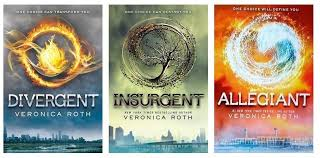
Oh my, people are very angry with the ending to the Divergent trilogy.  In fact, the readers who enjoyed Allegiant seem to be few and far between. What is it that has precipitated this reaction? Is it the shifting first person narration between Tris and Tobias?  It was a little difficult to track the multiple story lines while hopping from one point of view to the other.  Could it be the sad surprise at the end when a popular character makes a terrible sacrifice?  If you read the first two books of the trilogy, you should have been prepared for some pain.  The dystopian setting requires the characters to overcome their fears, sometimes at great personal cost.  There is death, destruction, sacrifice and difficult decisions facing each individual character in all three books.
A dystopia is the opposite of a utopia.  None of the challenges and choices should come as a shock to the reader.  In the Hunger Games trilogy, children kill other children to survive "a game" while people manipulate events to force them to fight.  For many of the people in the society, this is a form of entertainment.  The characters in the Maze Runner trilogy are manipulated multiple times and treated like expendable science experiments.  They are never given the full truth about their society and why they are being forced into horrendous circumstances.  They persevere through many trials in order to seek the truth and a possibility of survival.  In The Knife of Never Letting Go (Chaos Walking trilogy), the main characters are desperate teens who must struggle against evil adults and a broken society.  The author throws in a curve ball with the setting which is on a distant planet where the men's thoughts can be heard by the women which has greatly complicated relationships between the sexes.  Due to these circumstances, the planet that the original settlers thought would be their utopia has morphed into an awful dystopia. There too, the main characters are faced with many difficult choices and sacrifices.
Along with the twisted, repressive, controlling societies these characters must navigate, they are also struggling against themselves and their flawed natures. Just as in life, poor decisions will be made and bad things will result from them.  This is not the first time in teen fiction that something happened to a character causing readers to rebel.  The point is, you're talking about it. Unlike Marie Lu's Legend trilogy, teen books do not always have a happy ending. Most of the ones mentioned here contain a hopeful ending. Happy endings are not guaranteed....unless you're reading a romance.

Thursday, December 5, 2013

Andy the Library Squirrel and the Technology Tantrum

Sometimes a thoughtful gift really isn't a gift at all.  In fact, there are times when a gift may become a burden. The intention behind the present is usually noble.  Often it entails thoughts of making a loved one's reading experience more varied and pleasant.  The advertisement for the item promises that it is incredibly easy to use and that any necessary tech support will be available at all times.  Gentle, thoughtful, Buyer, please beware.  If the person receiving the gift does not regularly use modern technology, there are going to be issues. If the "giftee" does not understand how to use their gift, it is no gift at all.

Above you see Andy, Manitowoc Public Library's beloved Library Squirrel. The kindly ladies in the Children's Department taught him to read a long time ago. Andy began visiting us as a young squirrel when he attended Story Time with his mother.  His little eyes were barely open but the library became a refuge for him from his rowdy siblings (who were all banned due to their excessive chewing of library materials).  It was mutual love at first sight. (Baby squirrels are adorable.)
If you've seen Andy on our Facebook page, you know that he loves to help others.  He has spent time working on our Automated Materials Handler.  He has donated books to our yearly book drive, The Best Gift Ever.  (He still treasures his copy of Harold and the Purple Crayon that he received from us as a young kit.)  Andy is also an avid reader.
Unfortunately for Andy, the kind intentions of a generous benefactor have gone awry this holiday season. Someone thought that he would like to store his books on an eReader.  The thought was that Andy would be able to read at night, while the library was closed.  Andy would no longer get lost in the fiction stacks looking for his next favorite read. Andy would no longer have to wait for his holds to become available. He could just download the book and read to his little heart's content. They didn't realize that Andy enjoys browsing through the book shelves and he doesn't mind waiting for a book.  He's got plenty of material to enjoy while he waits.  
Sadly, Andy is having a difficult time with technology because his little paws just don't work well with touch screens.  He can read and munch nuts when we set the eReader up for him but squirrels are very active creatures. Although the device seems light to us, poor Andy cannot hold onto it nor can he carry it very far. It also doesn't fit in his nest.  We've tried to explain the concept of wireless technology to him several times and in return, he scolds us and demands that we figure out how to get the book he wants onto his device. Add onto that frustration the concept of having a holds list on electronic copies and you will understand why Andy has not been himself lately.
Fortunately, we have talked Andy down out of his tree.  We will all be helping him get used to his new device.  He is now receiving book and technology counseling.  This counseling is similar to the "I'm OK, You're OK" mantra.  It is acceptable to prefer books to eReaders.  It is natural to enjoy having access to many books on one device.  You can enjoy both things.  If Andy sounds like someone know, someone who may have received a gift they want to use but aren't sure how to use, send them to the library.  Don't let their gift drive them nuts like Andy!  

Thursday, November 21, 2013

Grab your popcorn and enjoy the ride

Once again it's time to break out the holiday movie favorites.  You cannot watch The Nightmare Before Christmas in the middle of May, it just doesn't work. But now it's November and Irving Berlin's White Christmas has suddenly transformed into the most popular movie and soundtrack of the season.  Some people can't wait for the endless reel of It's a Wonderful Life to be shown on TV and must take it home and watch it now to get into the spirit of things.  Another perennial TV favorite, A Christmas Story is one of those movies that gradually grows on the viewer.  (It's a matter of learning to appreciate the many humorous nuances in the movie.)  Who can forget the line, "you'll shoot yer eye out kid"?
Anyone can use the Internet and access a search engine to find "expert" opinions on the top Christmas movies of all time.  However, as with all lists that claim to catalog the "best of" anything, they are subject to differences of opinion and personal taste.  Die Hard, Home Alone, While You Were Sleeping, Bridget Jones's Diary, and When Harry Met Sally are examples of movies that claim to be quality holiday viewing choices. Movies like these can be enjoyed at any time during the year. Real holiday movies are applicable to the time of year.  People actively search the shelves for them in order to catch the holiday spirit.  Miracle on 34th Street, Elf, Muppet Christmas Carol, The Polar Express, Santa Clause (all 3), How the Grinch Stole Christmas (Boris Karloff version), A Charlie Brown Christmas, and Rudolph the Red-Nosed Reindeer are just a few examples of those holiday titles that you can live without for most of the year but are "must-haves" come November.
It's perfectly acceptable to be a fan of the old school titles like The Bishop's Wife, Christmas in Connecticut, Holiday Inn, or Meet Me in St. Louis; they warm the heart and fill the viewer with nostalgia.  It's not a crime to prefer to get your holiday adrenaline pumping with movies such as Gremlins, Rocky IV, The Long Kiss Goodnight, The Last Boy Scout, Enemy of the State, and Lethal Weapon.  Many people need a lift during this time of year and gravitate towards lighter fare like National Lampoon's Christmas Vacation, Scrooged, Fred Claus, Deck the Halls, Bad Santa, and Jingle all the Way.  The debate over which of these movies is the best can be an activity to enjoy with your family as you decide which ones you want to watch.  Whether you want to laugh, cry, or remember days gone by, these movies are available for you at your holiday headquarters-the library.

Friday, November 15, 2013

Remember the Spartans! (the way of life, not the football team)

It's here.  The time of year when credit cards and bank accounts start screaming for mercy.  We tell ourselves that this year we will be prudent and thoughtful in our spending.  Guilt will not influence holiday purchases.  Indecisiveness will not cause us to spend unwisely.  BOGO offers, cash back incentives, and ad campaigns that proclaim lowest prices or egg us on to buy quickly due to extremely limited quantities will not sway us.  We will shy away from signs proclaiming "Doorbusters". However, since society and the world around us won't let us skip the holiday season, it's time to strategize.
Some people throw themselves into the world of couponing with abandon year round.  It has become a family activity. Family members spend hours clipping coupons while others are frantically downloading coupon deals from the Internet.  A third person (the "Couponing General") peruses the local ads and calculates where to use the coupons to the best advantage while combining them with store card discounts and double coupon days to achieve the maximum discount nirvana.  The popularity of this activity has spawned popular shows like "Extreme Couponing" on TLC.  (A thoughtful person might say it has likewise contributed to the advent of shows such as "Hoarding: Buried Alive".)  Sometimes it feels like the couponers are involved in  a competition revolving around quantity not quality (or usefulness) of items.  Before you dive into couponing ask yourself; are you looking to save money on groceries or do you want to be the only person on your block with over 50 bottles of ketchup at your disposal?  (But they were only .50 a bottle!!!)  Your answer will determine whether you are "extreme" or merely a bargain hunter.
The clothing stores are already in full holiday discount swing.  Everything is on sale, everything.  Is it a bargain if you have to buy two items that are exactly the same thing in order to get a third free?  Are those name brand jeans from the outlet mall really worth the "discounted" price?  Shouldn't you buy things because you actually need them, not because they were an incredible bargain?  Are we really saving money if the store repeatedly rewards our purchases by giving us another incentive to come in and shop again, and again, and again?  Of course many those deals and incentives are tied to the store credit card, another avenue of revenue for the store. Gone are the days of our grandparents who used to get "two useful things" (most likely socks and underwear) "and one fun thing" for Christmas.  (There was a time not so long ago when three children were thrilled to SHARE the Atari game system they got for Christmas.  No child expected or received their own individual game.  Bonus if you got candy in the stocking that morning too.)
Once we are able to discipline the shopaholic that resides inside, we can approach the holiday shopping season with less trepidation and more determination.  After all, if we look at the bigger picture, there is life after the holidays.  (Remember the millennial scare in the year 2000?  Didn't the Mayan calendar have the end scheduled for 2012?  We're still here and so are the bills.)  Whether we're battle-hardened Black Friday goers or online shopping aficionados, there really is only so much stuff that we need or want.  So before you make your list and check it twice, remember to use the resources at hand to guide you through your shopping expeditions.  You may find that you'll enjoy your excursions more if you approach them thoughtfully, with a goal.  Realize that it would be nice to relax in January instead of trying to return unwanted, unnecessary gifts that you may have been "bargain-tricked" into purchasing.  Don't let the holidays get the best of you, become a holiday "prepper".

Friday, November 8, 2013

Semi-true Stories or "Hey, it could happen!"

Steampunk
To the person who loves history, some of the worst offenses authors of historical fiction make are an overload of period detail, characters using modern dialogue or behaving in a manner that is inconsistent with the time period, and re-writing history. We don't want well-known historical figures performing acts that are out of character, like pardoning their enemy instead of beheading them and marrying their widow for the estate or the inheritance. We can't stand it when people who we know are doomed (like Mary Queen of Scots) receive a surprise happy ending.  If someone is implausibly saved, (such as the fair maiden's rescuer appearing at the scaffold with a machine gun thanks to their handy time machine), the reader had better realize that this author is writing fantasy, science fiction, romance, or maybe a blend of all three.  It is not historical fiction.
One of the keys to an engaging story is a main character that invokes sympathy on the part of the reader.  In The Constant Princess, Philippa Gregory does an excellent job developing the character of Katherine of Aragon. Katherine begins the story as a young, headstrong princess of Spain who becomes the Princess of Wales and (eventually) the beloved wife of Arthur, the Prince of Wales.  Their romance is passionate but short lived.  On his death bed, Arthur extracts a difficult promise from his wife.  She is to deny the consummation of their marriage and set her sights on marrying his younger brother, Henry.
Although she should be headed back to Spain as a widow, her promise to Arthur and the political maneuverings of various European monarchs (including her former father-in-law) prevent her departure.  She allows Henry VII to believe that she might consent to his advances while remaining true to her promise to Arthur.  She becomes the "constant princess", bound by a promise and her own ambition.  What the author has done with this character is highlighted her triumphs and not her disappointments, which can be difficult when using historical figures.  Gregory takes the somewhat tragic life of Katherine of Aragon and turns it into an intriguing story about her personal life and loves and avoids creating an atmosphere of impending doom.
Historical fiction that centers on events, allows the author to create their own characters.  They can use these ordinary people to help lead the reader to a deeper understanding of historical events and their impact on lives. In Skeletons at the Feast, Chris Bohjalian used several real life resources mingled with historical facts to help him create both a realistic setting and characters.
The events in this book take place during the final months of World War II. A Prussian (German) family is fleeing their estate in the face of the Russian advance.  Along with their wagon and supplies, they are bringing their farm helper, a Scottish POW who also happens to be their daughter's lover.  Their goal is to head west through Poland and Germany until they reach the safety of the British and American lines.  Along the way they meet resistance fighters, concentration camp survivors, and German fanatics who refuse to see the reality of their country crumbling around them.  They also must face their journey without their father and older brother who feel honor-bound to rejoin the German forces despite the fact that they know they are most likely going to die.  The variety of characters in this book and the intense setting allows the author to show human nature at its best and worst.
No matter what type of historical fiction you prefer, if it's done properly it can take you back in time or lead you to a new understanding.  Maybe it will spark your interest in a person, time period, or event and lead to become an "expert" in that field.  Don't dismiss historical fiction or you may be doomed to read the same type of fiction over and over and over again.
Also recommended by the Manitowoc Public Library Staff:

Biographical Historical Fiction
Hemingway and Hadley
He's just into you for your money;
 but you've got the title to keep you warm.